Spectra Suite
A family of native macOS RF and imaging tools — built around a single design language, engineered to interoperate. Two products are shipping today; four more are on the way.
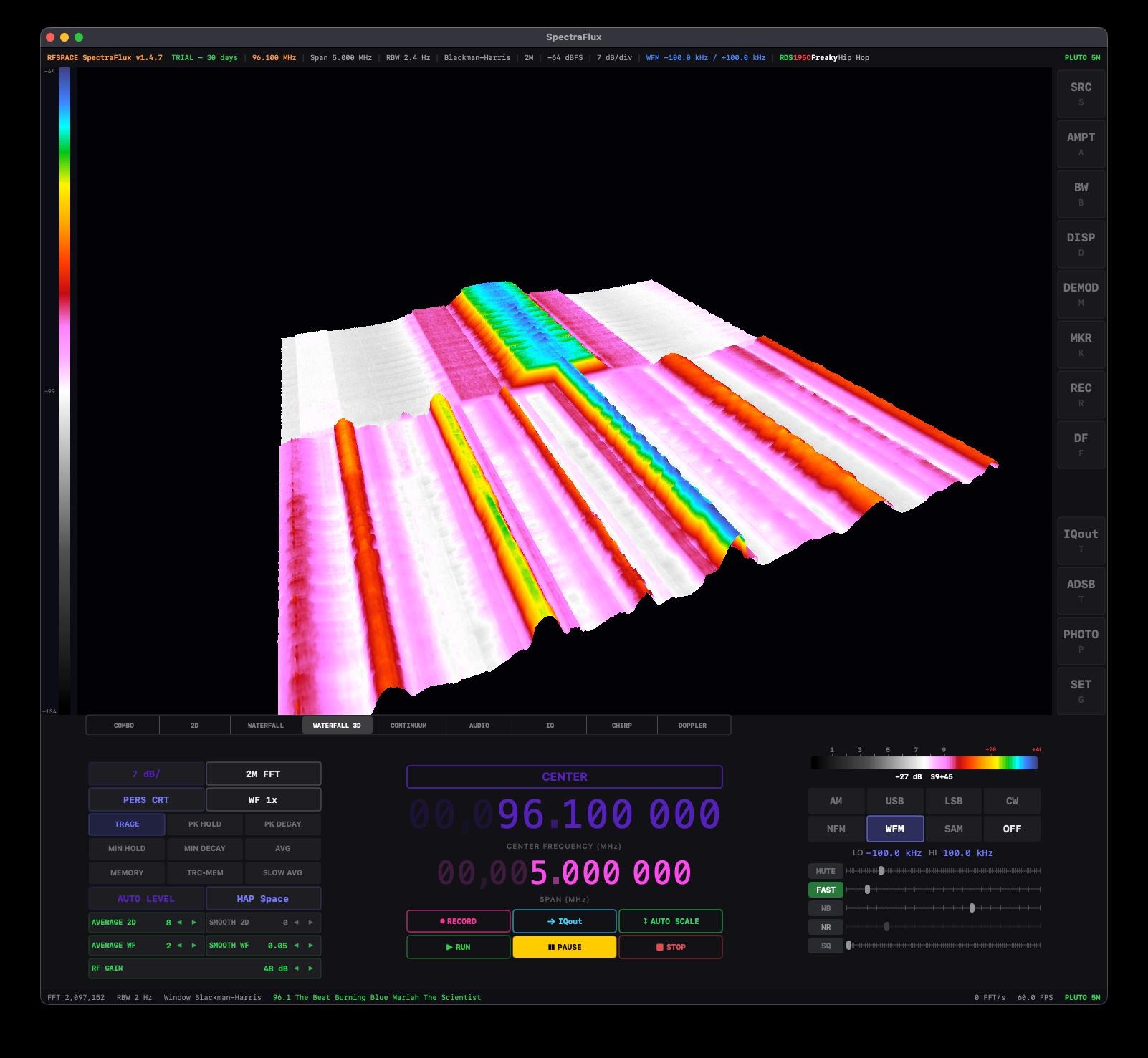
SpectraFlux
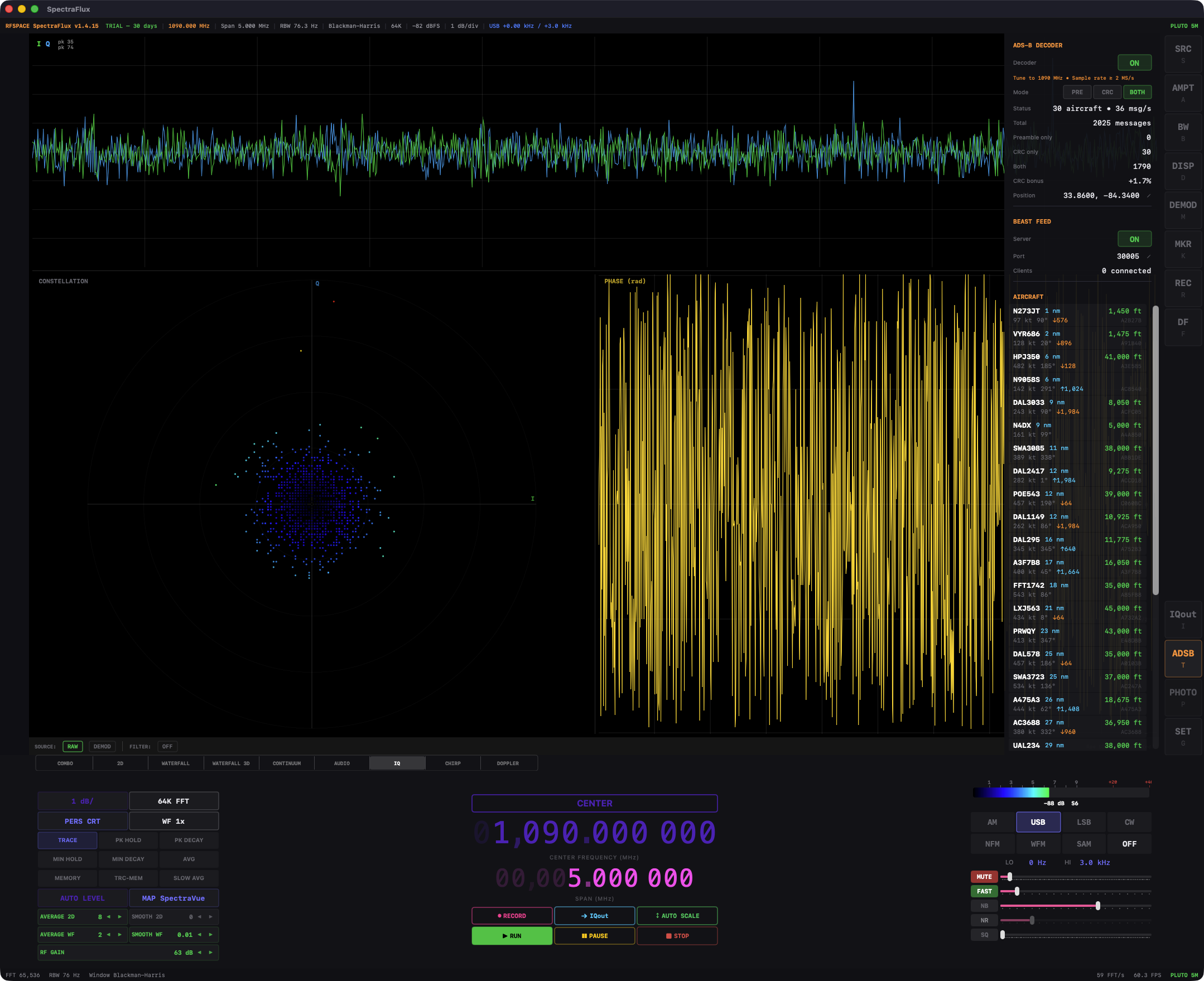
Native macOS SDR spectrum analyzer with a Metal-rendered 3D waterfall, full demodulation chain (AM / SSB / NFM / WFM with RDS), ADS-B + Beast TCP, recording in seven formats, MUSIC direction-finding, web remote, and rigctld for WSJT-X. Speaks to RFSPACE NetSDR / CloudIQ / CloudSDR / SDRanywhere, USRP B210, ADALM-PlutoSDR, IQ files, and the upcoming Nixara FPGA SDR.
Open product →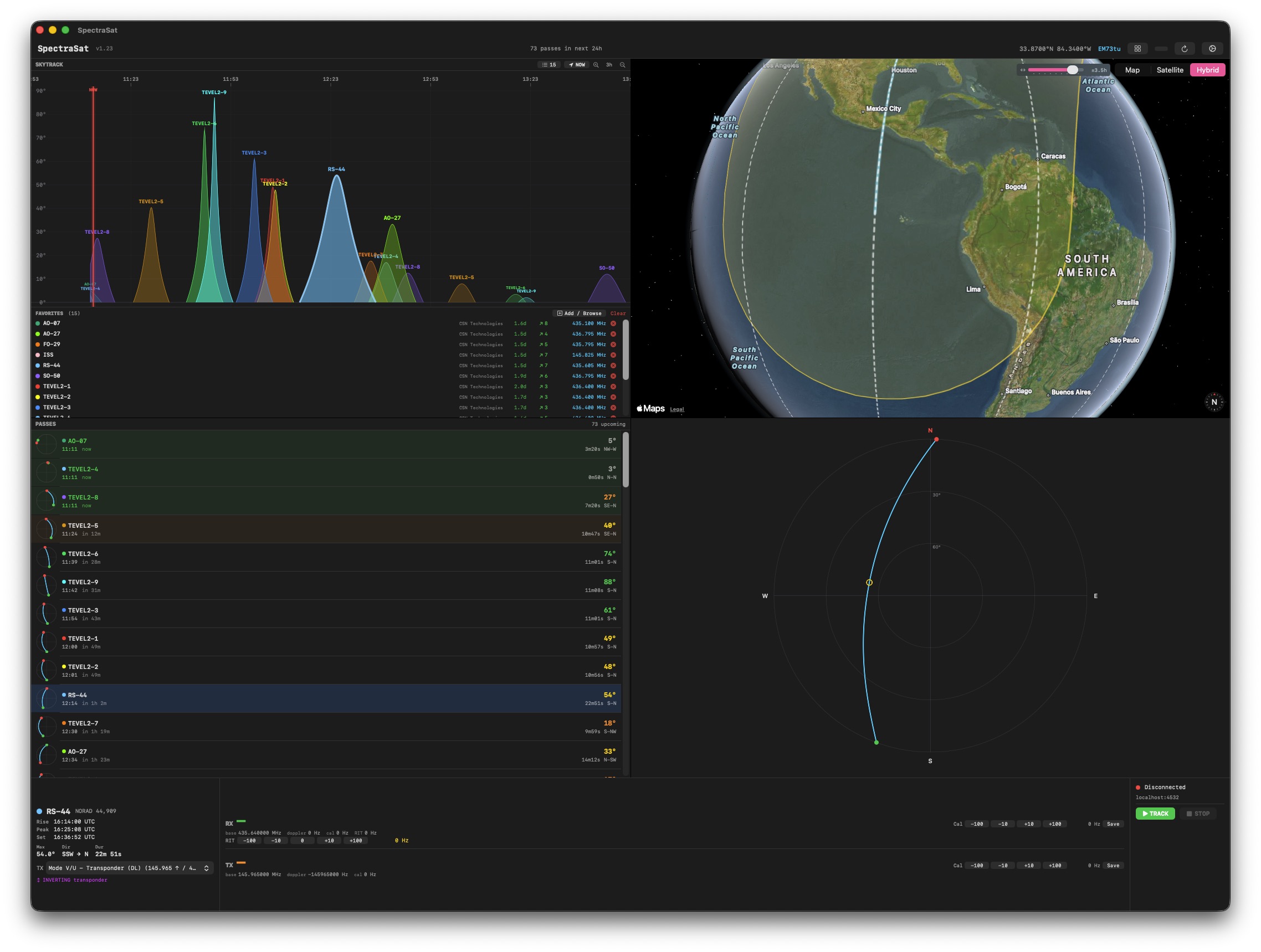
SpectraSAT
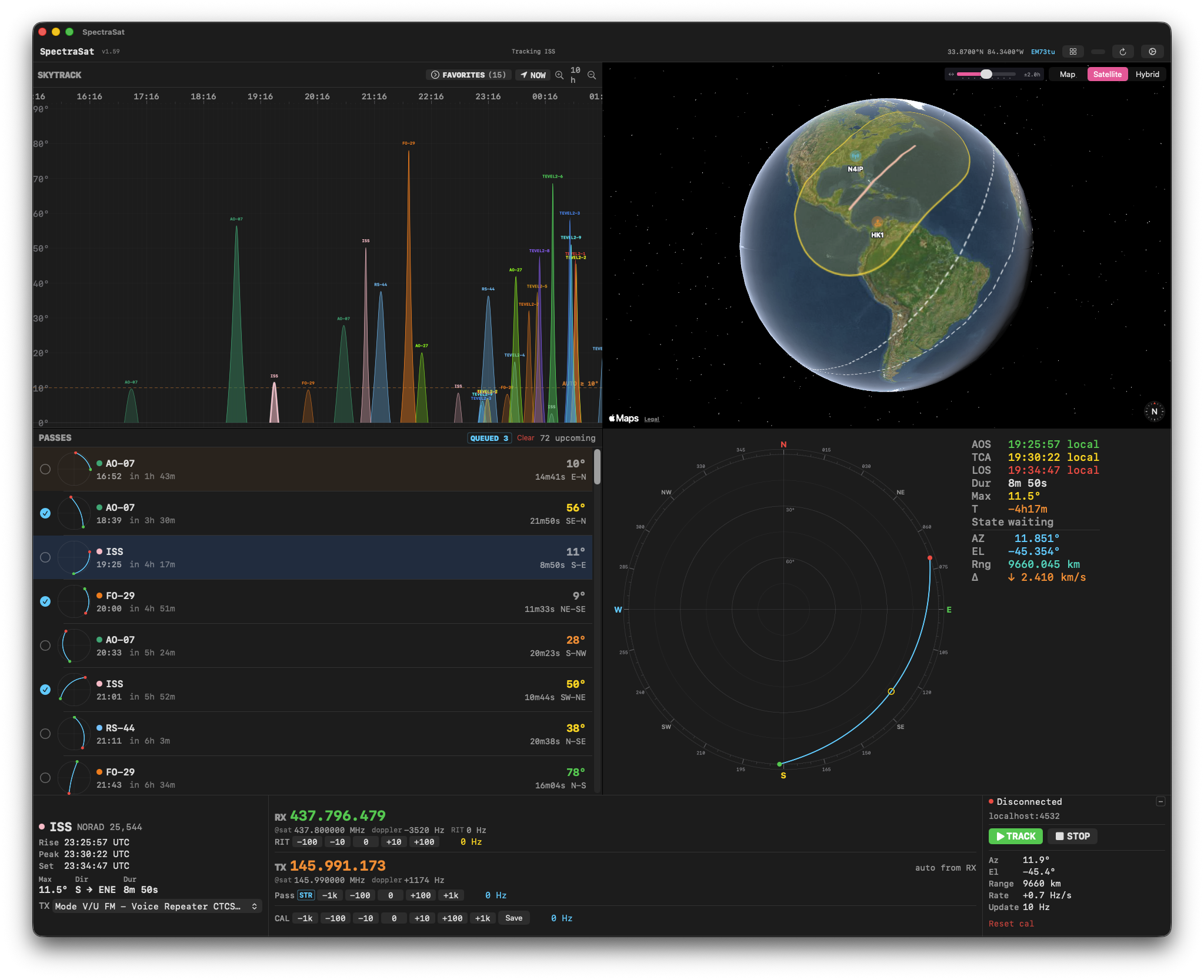
Native macOS satellite tracker — TLE / SGP4 propagation, polar pass plots, ground-track maps, live globe. Drives SpectraFlux's NCO for real-time Doppler correction via the new SAT_PROTO rigctld extension — carriers draw straight vertical lines on the waterfall.
Open product →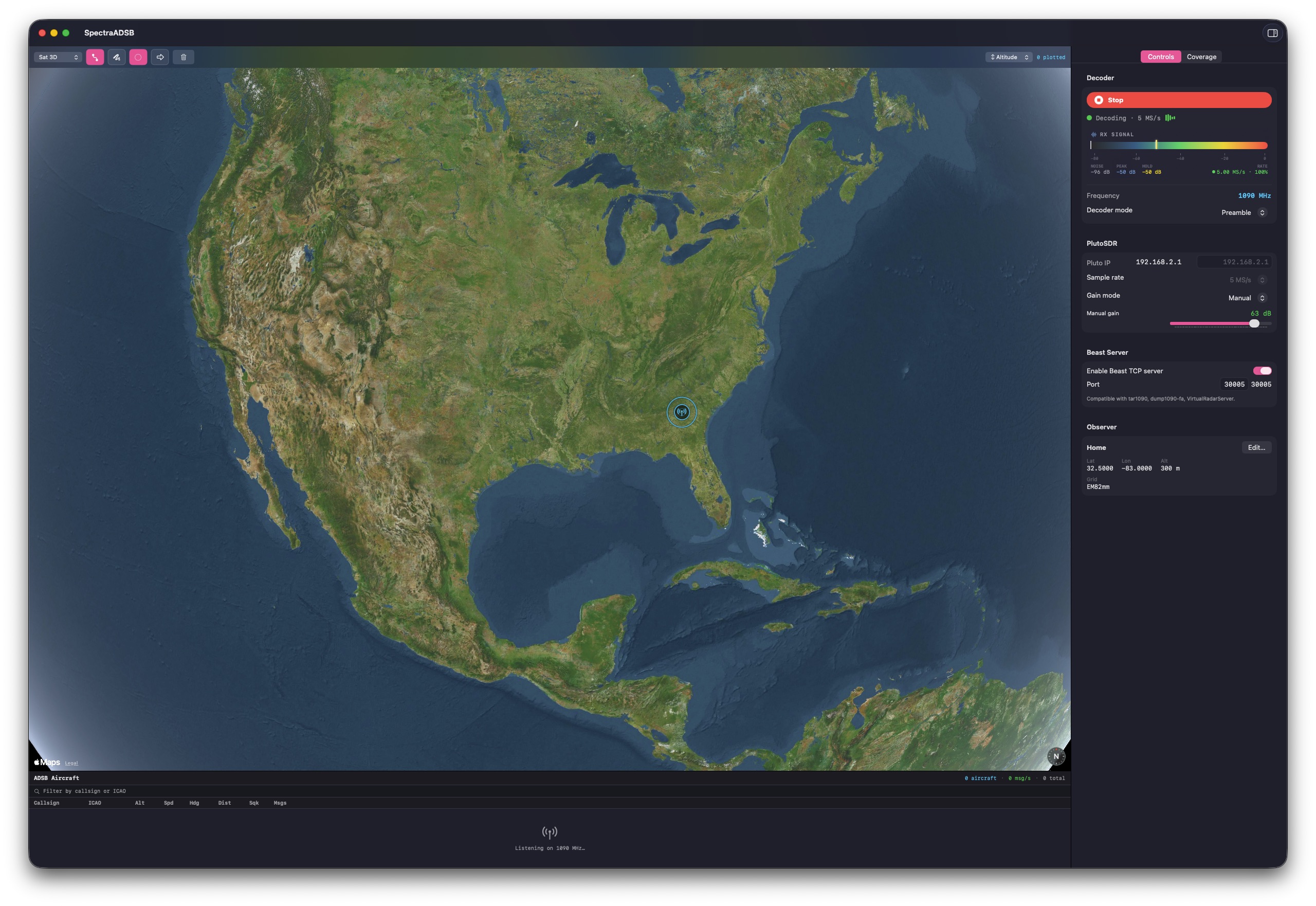
SpectraADSB
Local ADS-B reception on macOS, iPad and iPhone. Mode S decoder, CPR position resolution, live aircraft list with map, Beast output for tar1090.
Preview →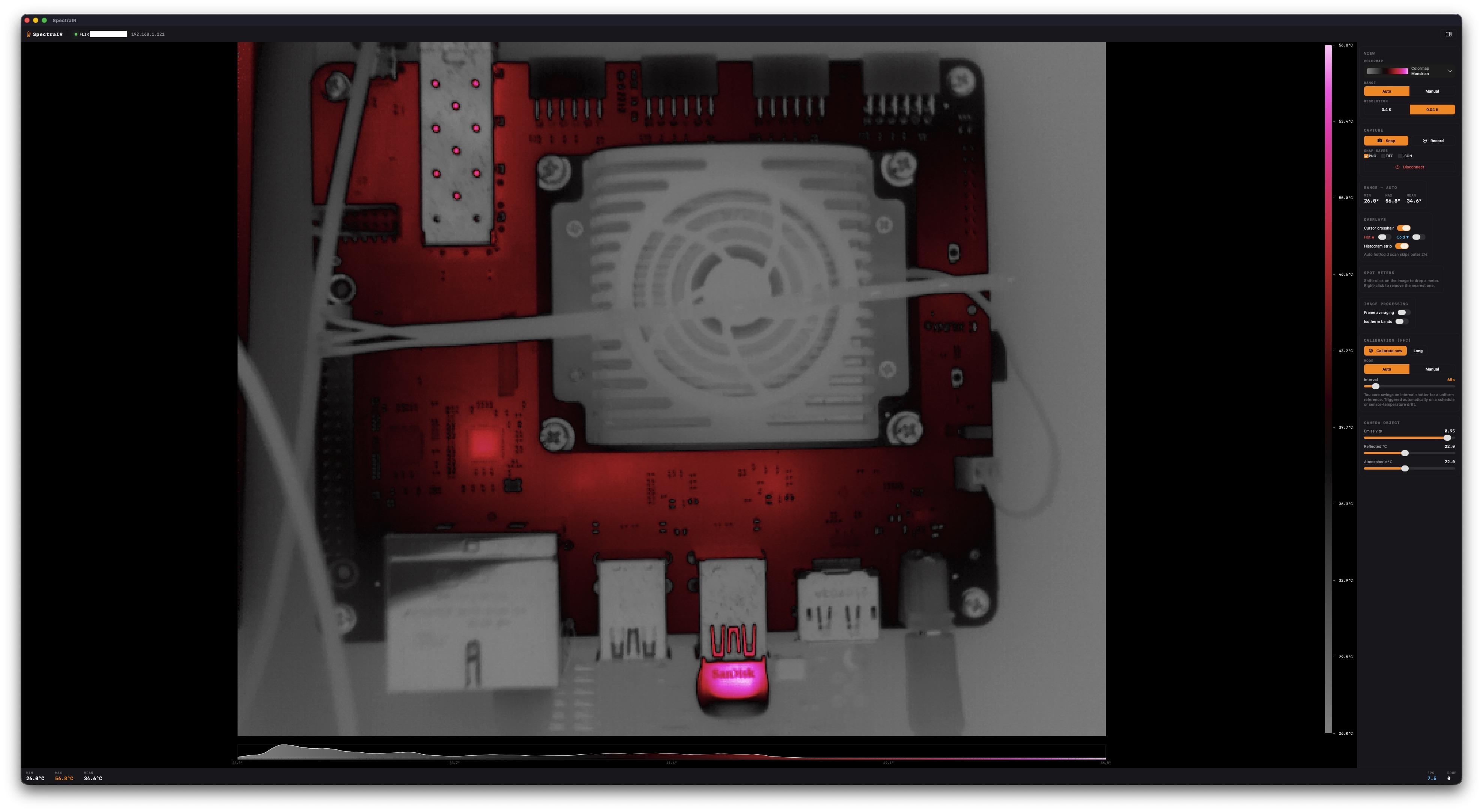
SpectraIR
Native macOS IR camera processing for GbE thermal cameras. Real-time radiometric display, palette library shared with SpectraFlux, recording, per-pixel metrology — same Metal pipeline.
Preview →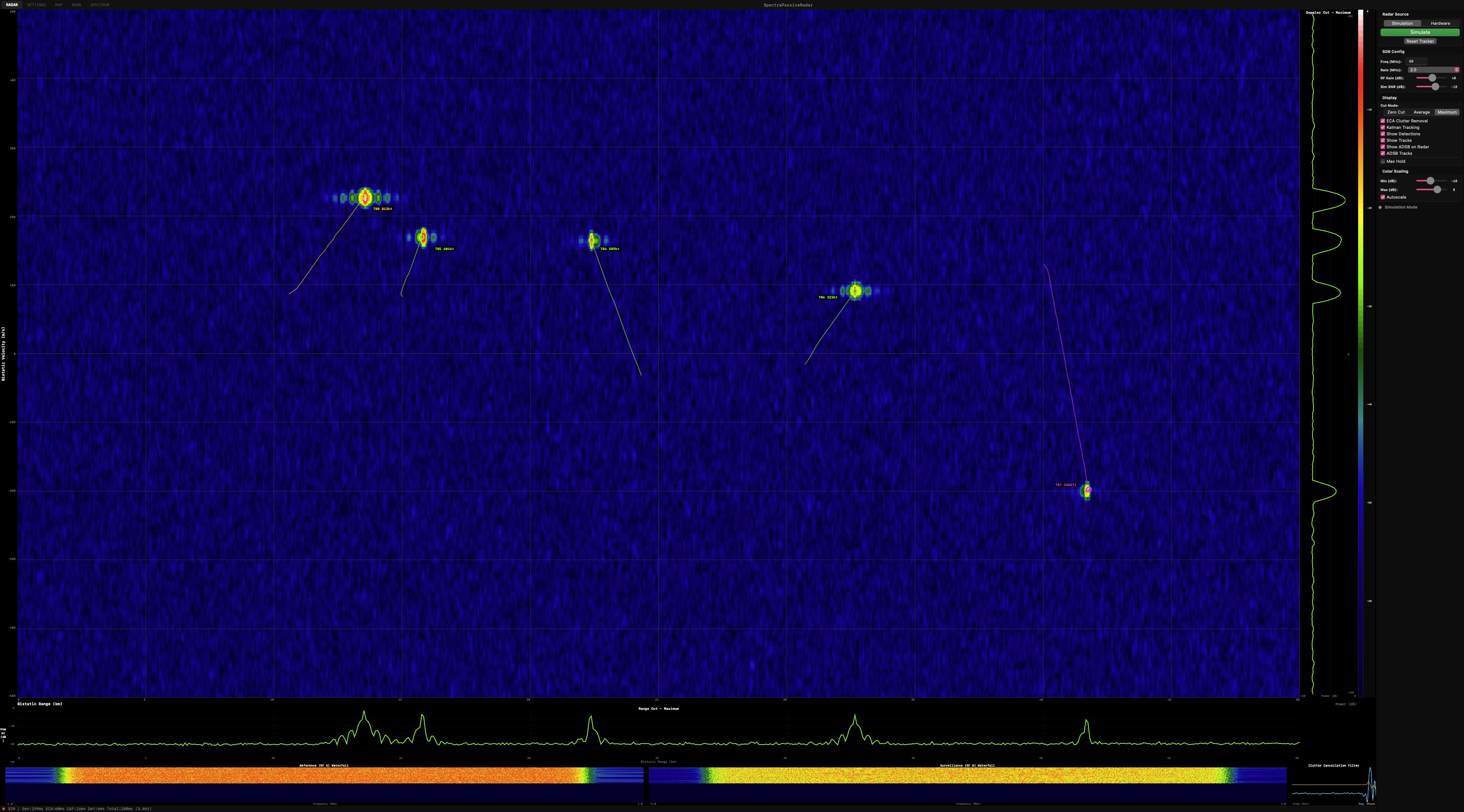
SpectraPassiveRadar
Passive coherent location using FM and broadcast-TV illuminators of opportunity. Range-Doppler maps, target tracking, future high-tech imaging modes.
Distribution restricted — dual-use export-control considerations.
Preview →SpectraFlux
The flagship — and the one you can run today. Native macOS, Apple Silicon, Metal-rendered. No installer, no dependencies.
What it does
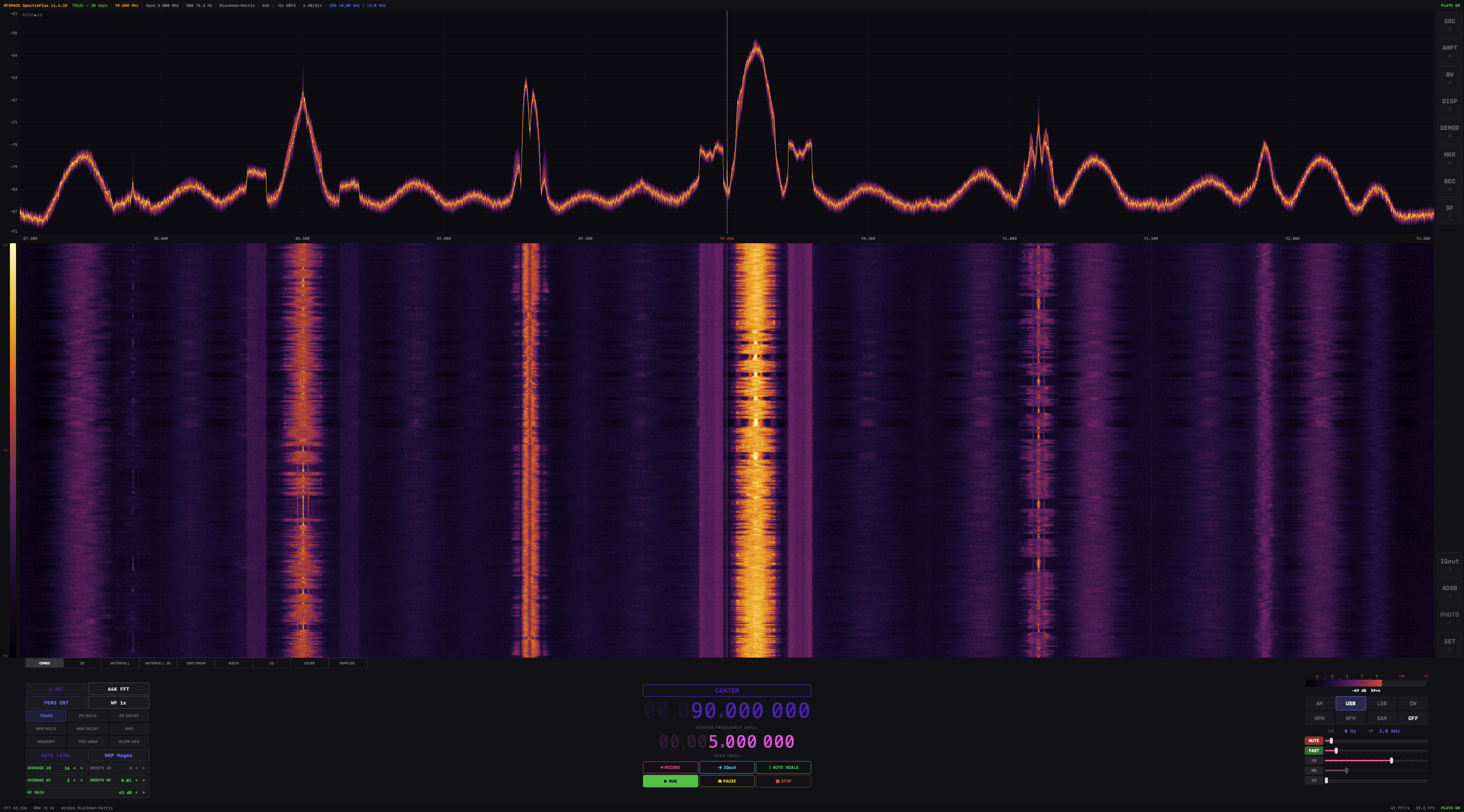
Spectrum, waterfall, demodulation, recording, ADS-B, direction finding, chirp dechirping. Connect any of the supported radios below — or use the built-in test signal.
Display & Analysis
- 2D + 3D waterfall GPU · Metal
- 27 colormaps cyclable
- 9 trace overlays peak / avg / min
- Phosphor persistence CRT-style
- 4 markers delta + peak search
- Independent AVG/SMOOTH 2D + waterfall
Signal Processing
- AM / NFM / WFM + RDS decoding
- USB / LSB / CW / SAM narrow filters
- AGC, NB, NR, Squelch CuteSDR-grade
- ADS-B decoder + Beast TCP server
- MUSIC DOA 4-channel coherent
- Chirp dechirper + RTI display
Recording
- WAV / SigMF / RF64 IQ formats
- Raw .cs16 GNU Radio
- strf .bin satellite tracking
- SIGPROC .fil radio astronomy
- Segmented recording gapless splits
- Spectrogram thread independent FFT
Connectivity
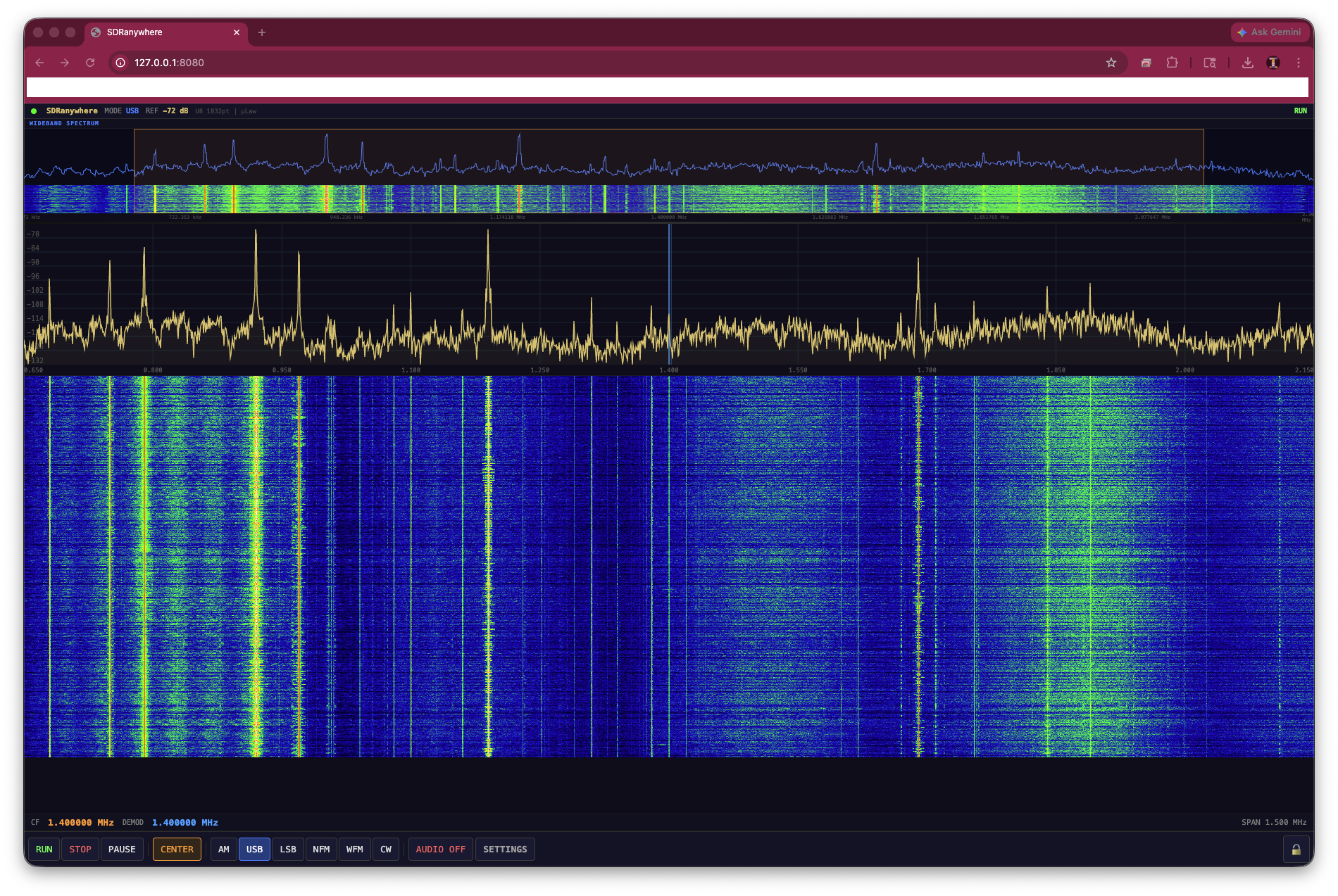
- Web remote browser / iPad
- Rigctld server WSJT-X / fldigi
- VRT IQ output UDP forwarder
- Doppler NCO SpectraSAT-ready
- Persistent settings UserDefaults
- Audio device picker BlackHole compat
Supported radios
No hardware? The built-in test signal works out of the box. When you connect a real radio, SpectraFlux speaks to any of these:
RFSPACE
- NetSDR + X2 dual-channel
- CloudIQ 1.8 MS/s
- CloudSDR 2.0 MS/s
- SDRanywhere thin client
Other SDRs
- Ettus USRP B210 via UHD
- ADALM-PlutoSDR 70 MHz – 6 GHz
- Generic VRT receiver VITA 49.0
- IQ files WAV / SigMF / .wv
- Nixara SDR in development
More views
Installation
No installer, no dependencies, no admin password required.
-
Download & open
Click the download button above, then double-click
SpectraFlux.dmgto mount it. -
Drag to Applications
Drag
SpectraFlux.apponto the Applications shortcut in the window that opens, then eject the disk image. You can launch it straight from the mounted image, but it goes away when the image ejects. -
Double-click to launch
macOS may briefly verify the app on first launch, then it opens. The Test Signal source is selected by default — no SDR hardware needed to start exploring.
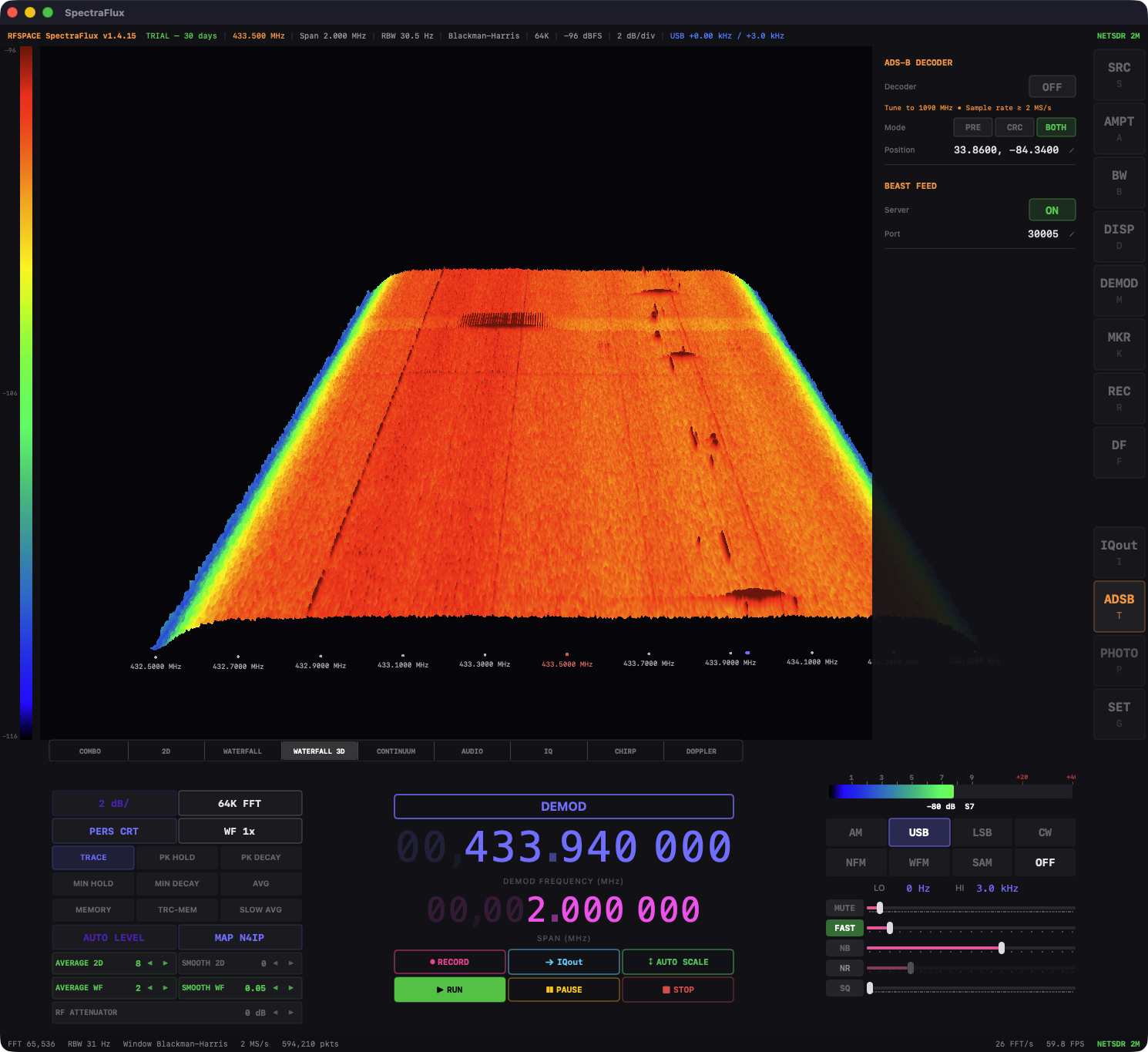
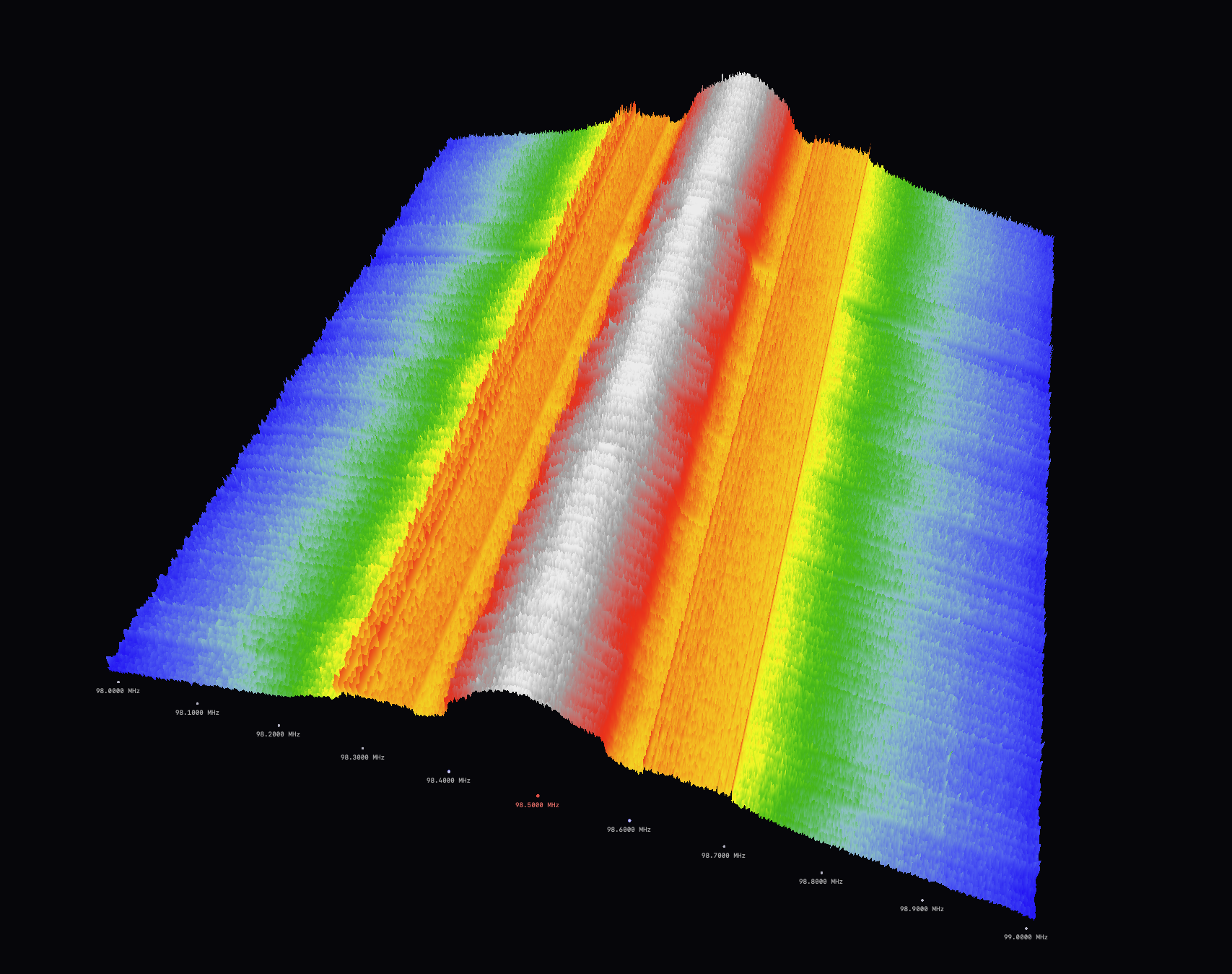
WATERFALL 3D tab. Drag to orbit. Scroll = zoom, Shift+scroll = vertical exaggeration, Cmd+scroll = ref level.
SpectraSAT
A native macOS satellite tracker built around the same Metal pipeline as SpectraFlux. SGP4 propagation, polar pass plots, ground-track maps — and a live link into SpectraFlux that finally shows the satellite's real rest frequency on the waterfall instead of a Doppler-shifted number.
SAT_PROTO — a clean rigctld extension
For 25 years, satellite trackers have crammed rest frequency and Doppler shift into a single set_freq command — leaving the receiver unable to tell the two apart. SpectraSAT uses the new SAT_PROTO v1 extension to send them as separate atomic fields. The result is a transponder waterfall where the satellite's actual transmit frequencies appear on the X axis and stable carriers draw straight vertical lines instead of Doppler curves.
- Five new commands:
\sat_caps,\sat_aos,\sat_los,\sat_dl,\sat_ul - Auto-detects support via
\sat_caps, falls back to legacyset_freqfor any other rigctld radio - Backwards compatible — every existing tracker and radio continues to work unmodified
- Public spec, CC0 / public domain — implement freely in any radio or tracker
What SpectraSAT does
- SGP4 / SDP4 orbit propagation with auto-updating TLE catalog
- Pass scheduler — queue any number of birds, automatic AOS / LOS handoff between passes
- Polar pass plots, ground-track maps, live globe view with footprints
- Per-bird transponder calibration — measure your bird's actual oscillator drift, save it, and SpectraSAT applies it transparently on every future pass
- Independent uplink / downlink VFOs with separate Doppler tracking for each band on V/U and L/U birds
- Drives SpectraFlux's NCO over rigctld in real time — per-sample frequency correction, no tuning hops, no glitches across the pass
SpectraADSB
Aircraft on a map, live, on every Apple device — without the rest of the SDR application weighing things down. Same Mode S / ADS-B decoder as SpectraFlux, packaged for the people who only want to watch traffic.
Native on macOS, iPadOS and iOS. The Mode S decoder runs locally; the map view is built on MapKit. No cloud hop, no subscription, no per-feed paywall — your antenna, your data.
- Mode S / DF 17–18 decoder with CRC-24 and preamble paths
- CPR even/odd position resolution, NL latitude zone tables
- Aircraft list with callsign, altitude, speed, vertical rate, lat/lon
- Beast TCP output for tar1090, Virtual Radar Server, FlightAware
- Background reception on Mac; live map view on iPhone & iPad
SpectraIR
Thermal cameras, native and fast. Real-time radiometric processing for GigE-Vision and ONVIF thermal sensors, rendered through the same Metal pipeline that drives SpectraFlux's waterfall.
Same colormap library as SpectraFlux — including the new Mondrian and Outdoor Alert palettes — driving a live thermal feed from any GbE camera on the network.
- GigE Vision and ONVIF thermal camera support
- Per-pixel metrology — point, area, line profile, isotherm
- Histogram equalization, AGC, manual range, fixed-point lookup
- Recording in radiometric raw + colormapped video
- Shared palette engine — every SpectraFlux colormap available
SpectraPassiveRadar
Passive coherent location using illuminators of opportunity — FM broadcast, broadcast TV, and other ambient transmitters. Detect and track without emitting a single watt.
Two-channel coherent receive (reference + surveillance), cross-ambiguity processing, range-Doppler maps, and CFAR target detection. Several future high-tech imaging modes are in development.
- Multi-channel coherent IQ acquisition with the Nixara FPGA SDR
- Reference / surveillance channel cross-ambiguity processing
- Range-Doppler maps, CFAR detection, target tracking
- Bistatic geometry display with bistatic-iso-range contours
- Future imaging modes (research-mode, undisclosed)